
History of delta theta sigma
BETA CHAPTER – THE PENNSYLVANIA STATE UNIVERSITY
Founding of Delta Theta Sigma
In the spring of 1906, several men gathered together in a rooming house at 175 West 9th Avenue in Columbus, Ohio. The idea, conceived primarily by three men, Maxwell Corotius, Samuel N. Kerr, and Stanley B. Stowe, was the actual beginning of Delta Theta Sigma at The Ohio State University. The fraternity was incorporated under the laws of the State of Ohio on April 5, 1907, with 17 charter members.
The name, Delta Theta Sigma, and the four-fold purposes of the fraternity were drafted with the advice of Professor Smith of the Greek Language Department at The Ohio State University. The first fraternity pin was designed by Samuel N. Kerr, one of the founders.
The Delta Theta Sigma idea was contagious, not only at The Ohio State University but also on many other agricultural college campuses throughout the Midwest. Within a few years, chapters had been organized on ten other campuses. At a national convention in 1912, all of the chapters except the original chapter at The Ohio State University voted to make Delta Theta Sigma an agricultural honorary fraternity. The local chapter at The Ohio State University retained the original name, Delta Theta Sigma, the other ten chapters, therefore, assumed the name Gamma Sigma Delta.
On November 26, 1927, representatives from Delta Theta Sigma at The Ohio State University, Alpha Gamma Phi at The Pennsylvania State University, and a former Farmhouse Chapter at the University of Wisconsin met in Pittsburgh, Pennsylvania. The meeting began at 10:00 a.m. in Room 211 of the William Penn Hotel. The representatives were as follows:
Delta Theta Sigma
M.P. Durkee
Guy Miller
Alpha Gamma Phi
S.B. Wingard
F.W. Morrow
J.K. Stern
Farmhouse
George Helz
G.W. Burgardt
The meeting, with M.P. Durkee presiding, resulted in the formation of a new national agriculture fraternity, Delta Theta Sigma. A tentative constitution was drafted and soon adopted by all three local organizations. In the afternoon of the same day, national officers of the new fraternity were elected as follows:
Master Chancellor
M.P. Durkee,
The Ohio State University
Treasurer
S.B. Wingard,
The Pennsylvania State University
Scribe
G.F Burgardt,
The University of Wisconsin
After considerable discussion, a new pin and shingle (membership certification) were designated and approved.
The Years of the Fire
The year of 1958 put Beta Chapter at The Pennsylvania State University and its members, to the ultimate test as the chapter house was the victim of a costly fire during the winter of 1958. According to an article in the Centre Daily Times that day, active brother Donald Alcorn and fraternity cook Annie Heaton detected smoke at about 6:30 AM on February 19, 1958, in different locations within the house located at 126 East Fairmount Ave. Both immediately alerted others and all the occupants were aroused and prepared to evacuate. As they got dressed and tried to save clothing and other belongings, the smoke spread up the front stairs from the basement to the third floor. Many recalled dense smoke inhibiting breathing and sight as they made their way to the rear exterior fire escape. President James Compton first attempted to call the fire department from a second-floor phone, but found it was already dead. Fortunately, he was able to make his way through the smoke to the first floor where a phone was still operable. By the time Alpha Fire Co. firemen arrived the house was fully involved with smoke emitting from various locations. Brother Fred Schuetz recalls standing on the exterior fire escape reading from a house roster to call out each occupant’s name as they stood below in the cold parking lot to assure that all had escaped safely.
The temperature that morning was about 10 degrees Fahrenheit and the brothers huddled in the parking lot and on the street, some wrapped in quickly grabbed blankets, others in the most readily available jackets, not necessarily designed for the frigid temperatures. Neighboring fraternities offered warm shelter and coffee, but many stayed in the cold for several hours as the Alphas battled the blaze for nearly four hours and called for additional help at 7:45 am. Four pumpers and seven hoses were employed before the fire was finally extinguished and the fire chief reported he had to send for extra gasoline to replenish the rapidly diminishing supply in the tanks of the pumpers. Hoses were extended to hydrants on both Allen and Pugh Streets and traffic on Allen was completely re-routed for a time. Firemen stated there were no fire breaks in the stud spaces of the structure providing a path for the fire to spread quickly through the exterior walls from the basement to the third floor. The house was the home of our fraternity from 1923.
As the day wore on it was apparent the structure could not be re-occupied, and the brothers set out to make do with the clothes they wore and what they were able to carry. Those who were able to salvage more shared extra layers with those who escaped with the minimum. The newspaper reported one brother saved only what he could hold in the palm of his hand – his wallet and checkbook.
President Compton and Alumni Association president Fred Hughes and Art Nesbitt led the contacts with the University and community. In a matter of hours, the University offered lodging in a barracks-style dorm that had been built as temporary housing and was scheduled to be razed in a matter of weeks to prepare for the construction of the high-rise Pollock Dorms familiar to students today. State College area businesses quickly came forward to help. A local laundry provided bags and laundered all the members’ clothes that were retrieved after the fire before the smoke damage permanently set in. Several members who lost all their clothing in the fire were given new suits by Jack Harper’s Men’s Store and all the members were given a significant price discount for the purchase of new clothes for several months following at other men’s stores. Complimentary meals were offered to the active members for several days until arrangements were made for group dining.
Of great importance was the opportunity organized by House Advisor Glenn Kean for the fraternity to have their mid-day and evening meals prepared by our cook at the Evangelical United Brethren Church, now the Albright Bethune United Methodist Church, of which Brother Kean was a member. The arrangement allowed the actives to continue to have Mrs. Heaton prepare the meals so they could continue to dine together and especially to continue hosting an active rush program.
During the spring semester, the local Alumni led by President Fred Hughes, Vice President Tom King, Secretary Don Cross, Treasurer Horace “Busty” Mann, Don Ace, Art Nesbitt, and others worked many hours to negotiate an insurance settlement, sell the Fairmount Ave. property, establish an alumni fundraising campaign, acquire financing and locate a property suitable for a new house.
Amazingly, a Centre Daily Times article on April 26, 1958, announced the purchase of the three-story stone house at the corner of West College Avenue and North Patterson Street which would become the new home of the Beta Chapter of Delta Theta Sigma. The Spring Dinner Dance in 1958 was held at the Eutaw House in Potters Mills, a popular steak house at the time, and the plans for the fund-raising campaign to purchase the new property were outlined in a very long well-attended Alumni Association meeting.
As the spring semester drew to a close, the critical need to attract a large, quality pledge class to fill the planned new house in the fall was apparent. Local alumni planned and financed a dinner at the Penn State room of the Nittany Lion Inn to give assurance to the rushees who received bids that they would have a house to move into in the fall. Don Ace gave a stirring and memorable speech describing the lifelong values of fraternity membership. Ten attendees accepted their bids shortly after the dinner and before the end of the semester, twenty-one pledges were accepted into the largest pledge class ever for the fall. These members of the graduating class of 1961 have continued their bond through annual gatherings for more than five decades, perhaps being the closest of any class and fulfilling Brother Ace’s promise of the value of a lifelong relationship. Among them is Paul Semmel who served as president of the Beta Chapter Alumni Association beginning in 2010 and led our fraternity for 10 years, at a time when the future of Beta Chapter was again uncertain.
Members can hardly imagine the hours of work and faith that was required to bring together the identification, financing, and purchase of the property at 101 North Patterson St. and then design and build the addition containing the kitchen and dining room plus second-floor study rooms in time for the fall semester to begin. Brother Les Moyer, a retired vo-ag teacher and local contractor served as the builder and worked with the building committee to complete the construction in the short time allowed by the summer break. Although the addition wasn’t entirely finished on move-in day, about 40 brothers and pledges set up their new home before classes began.
The Ethan “Beef” J. Wolfe Scholarship

In the late hours of December 24, 2013, Ethan “Beef” J. Wolfe, 22, of rural Centre Hall, died near Rebersburg, PA, as a result of injuries sustained in an automobile accident. Ethan graduated from the local Penns Valley Area Junior-Senior High School in 2009, where he was active in FFA, the Penns Valley Marching Rams and the SADD program. He was also a member of the Centre Hall 4-H Ag Club where he showed Market Swine at the Centre County Grange Fair for many years. He was also an active member of the NRA and the National Wild Turkey Federation. Ethan had been a farm assistant at Penns Cave and at the Penn State Agronomy Research Farm and also assisted with the operations of the family farm. He was a Junior at Penn State University majoring in Agricultural Sciences with a focus in Agronomy. He was a dedicated brother of the Beta Chapter of Delta Theta Sigma Fraternity, the current President of the Penn State Agronomy Club, and was to be pictured in the Men of Agriculture calendar for 2014. He enjoyed farming, hunting, fishing, camping, and reading Western books and was the epitome of an outstanding brother of our organization. Brother Wolfe was the Vice President at the time of his passing.
In his honor, a scholarship fund was created to provide aid to an active member of Delta Theta Sigma at The Pennsylvania State University. Each year, in April, a scholarship clay-shoot is held at the Warriors Mark Wingshooting Lodge and Kennels located in Houtzdale, PA. On average $8,000 is raised for the scholarship fund. In addition, sponsors donate goods and a firearm to auction off for additional funds to be raised.
The More Recent Years
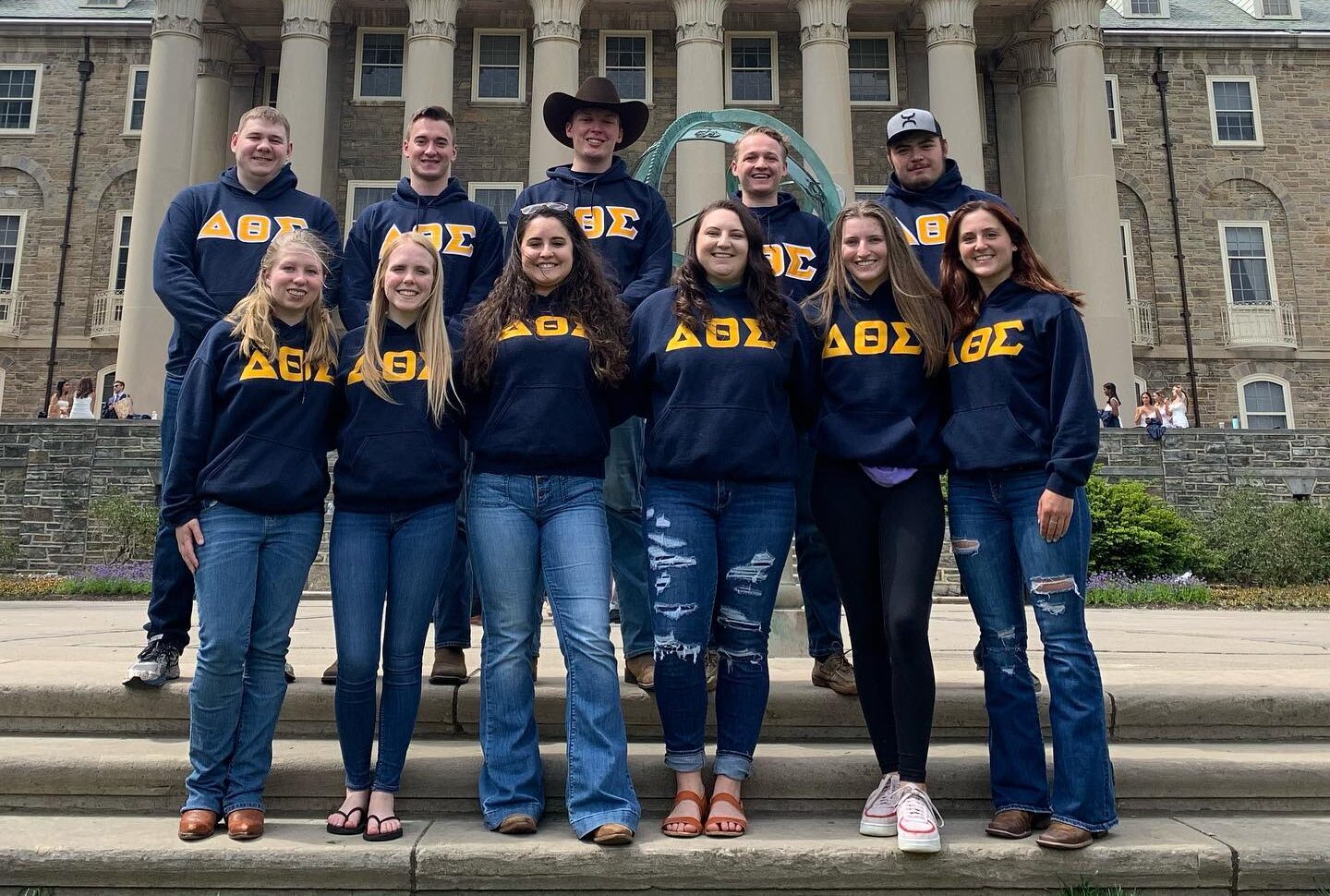
As of the 2023-2024 academic year, active members of Delta Theta Sigma continue to dedicate themselves towards the original purpose and ideals that the fraternity was founded upon: promoting agriculture, securing a higher degree of scholarship for the students in the College of Agriculture, fostering the spirit of brotherhood and camaraderie, and promoting social and cultural unity.
Beta Sister History
In the Fall of 1970, the Delta Theta Sigma Beta Chapter brotherhood unanimously decided to initiate the “Little Sister Program.” Nine bids were given, and eight girls completed a three-week pledging program. Their activities included “finding dates for (brother) pledges, helping to decorate for parties and mending tears and sewing buttons on tattered articles.” As a special project at Christmastime, they made pounds of fudge to be sent to alumni serving in Vietnam. On January 17th, 1971, the first Little Sister’s of Delta Theta Sigma were inducted including Brenda Bachman (Coplay), Laurie Conrad (Harrisburg), Marina Drylaak (Aliquippa), Kathy Fehl (Canonsburg), Ann Muller (Hellertown), Carol Ocker (Shippensburg), Sally Quinlin (Pittsburgh), and Jan Wagner (Tionest). The addition of the “Little Sister’s Program” added a spark of interest to fraternity living and a new family atmosphere.
(Source: The Harvester, Spring 1971)
READ MORE
